Recently, Ethiopian Diaspora stories project had an email
interview with Makonnen Araya, the author of “Negotiating A Lion’s Share of
Freedom-adventures of an idealist caught up in the Ethiopian civil war.” In the
interview, you will find some answers as to what motivated Makonnen to write
this book, the message he wants to pass to his audience, his upbringing, the
hardships he faced along the way, and what lessons if any that he has learned
from these experiences. We find his book
and his story to be beneficial to the diaspora community and the global community at
large in understanding the period after the downfall of Emperor Haile Selassie.

EDSP- Your book "Negotiating a Lion's Share of Freedom" focuses on your involvement in the Civil War that followed the Ethiopian Revolution of 1974. It is a fascinating personal account of how an educated professional living in the capital city of Addis Ababa became caught up in the political turmoil of the time, fleeing the capital after being targeted by the military government and then living for years in rebel-held territory as a guerrilla fighter and peasant organizer.
What circumstances led to you becoming a fugitive wanted by the military government?
I was actively involved in my Kebele — my local community organization — where I was vocal in criticizing the Dergue, the military junta that took governmental power overthrowing the monarchy headed by Emperor Haile Selassie. This led to my being labelled as an enemy of the government. One night in April of 1977, soldiers raided my residence to arrest me and possibly to execute me on the spot as was then the norm of the military dictatorship. Fortunately, I escaped the planned arrest and possible execution. Following that, I became a fugitive in Addis Ababa on the run from the law with no hiding place or place to live. Fortunately, after two months of such a nightmarish existence, I escaped to Asimba, a rebel-held area in the mountainous region of Tigray. There I joined the guerilla fighters of EPRA, the military wing of the Ethiopian People's Revolutionary Party (EPRP).
EDSP- Can you describe your upbringing, occupation and your overall family status prior to becoming a fugitive?
I was born and raised in Kullubi, a village in the province of Hararghe in eastern Ethiopia. My paternal grandfather was one of the three priests who in 1882 (Ethiopian calendar) brought to Kullubi from Bulga, a district in Shoa Province, the Tabot of Saint Gabriel (a replica of the Ark of the Covenant) to establish the church. I served there as a deacon before beginning my modern education in Dire Dawa. After graduating from high school in Harar, I attended Haile Selassie University in Addis Ababa. By the time, I was suspected as anti-Dergue and went into hiding. I was working as an attorney for the Commercial Bank of Ethiopia.
EDSP-When does the story in your book begin? What is it all about?
The story portrayed in my book begins in April of 1977 with my going into hiding after learning that there was to be a government crackdown on my neighborhood targeting individuals suspected of anti-government activity.
EDSP-What was the most perilous experience you encountered?
After months on the run from government agents seeking to arrest me, I was on the last leg of my journey to freedom. I was to meet a guide who would facilitate the escape of my four friends and I to Assimba, the rebel-held area. I did not know the man, but I had a password to
meet him at a specific location in the City of Makalle, capital city of Tigray Province. I went there at the appointed time. A man was standing there that met the description I was advised to look for. A Land Rover was parked across the intersection. As I walked closer, I noticed the heads of three people bobbing in the front seat of the car. I immediately suspected that to be a trap, set up by government agents to capture fugitives like me coming to meet the guide. Ignoring the person who was about five feet away from me, I continued walking.
Years later, I learned that the man was indeed our would-be guide but had been captured by the security forces. By using him as a bait the agents had captured three other groups of fugitives, a total number of 18 before my group arrived there. All those captured thus were later taken to Addis Ababa where they were executed en masse as enemies of the Dergue.
EDSP-Once you arrived in the rebel-held area you spent time at a guerrilla training camp. As someone accustomed to city life, what aspects of the guerrilla life were especially challenging?
Once I was in the guerrilla training camp, I found every aspect of life challenging, wearing a great deal of my physical and mental endurance. To begin with, the so-called camp was just a wilderness located in a semi-desert and very hot dry river valley. It had no other special landmark to its credit.
We cooked our own food of boiled corn or bean seeds (nefro), dry-roasted seeds (kolo) and baked bread in an open kitchen in the bush under some acacia trees. To fetch our provisions, every other week or so, my group traveled along rough, treacherous mountainous path to our supply store located half a day of foot travel away from our camp. At the time, my group consisted from 16 to 20 individuals.
At night, rain or shine, we slept in the open, either in a desolate bush or in a dug up hole on top of a hill. We wore the same cloth and a pair of shoes day and night. We left our sleeping place at 5 a.m. to start our daily physical training in the art of guerrilla war. We had no breakfast.
The whole time I was there, my feet and legs remained covered with wounds from scratches and stumbling over tree roots or rocks. There was no medicine available for that. At the training camp it did not take much time for everyone one of us before being emaciated for lack of sufficient and proper diet. Except for drinking water from the only well in the area, there was not enough water for cleaning ourselves or our clothes. On top of that, it did not take long for lice to dominate our miserable lives.
It took us some months living under such condition before completing our training program and left the place.
EDSP-In your book you talk about resigning from the guerrilla army, EPRA. You say "thereafter you headed alone on foot to Sudan to seek asylum and lead a life as an immigrant abroad". How did you make it to reach Sudan and then move on to enter the USA in 1980?
After staying for two years with the EPRA, suffering from disillusionment and frustration, I was forced to negotiate with the rebel leaders for my own individual freedom and life. Once I quit the guerrilla movement, I immediately started the long journey that would take me to exile. After a few days of arduous journey through the rough, mountainous and treacherous landscape, starting from the highland of Tselemt, I reached the town of Ady Remetse in Welkait. There I was stranded. I could not continue with my intended journey to Sudan for lack of a guide. If one tried to do so certain death was imminent. As a result, I stayed in the town close to two months until seven comrades and I found a caravan of peasant smugglers of goods who allowed us to travel with them to Sudan.
What circumstances led to you becoming a fugitive wanted by the military government?
I was actively involved in my Kebele — my local community organization — where I was vocal in criticizing the Dergue, the military junta that took governmental power overthrowing the monarchy headed by Emperor Haile Selassie. This led to my being labelled as an enemy of the government. One night in April of 1977, soldiers raided my residence to arrest me and possibly to execute me on the spot as was then the norm of the military dictatorship. Fortunately, I escaped the planned arrest and possible execution. Following that, I became a fugitive in Addis Ababa on the run from the law with no hiding place or place to live. Fortunately, after two months of such a nightmarish existence, I escaped to Asimba, a rebel-held area in the mountainous region of Tigray. There I joined the guerilla fighters of EPRA, the military wing of the Ethiopian People's Revolutionary Party (EPRP).
EDSP- Can you describe your upbringing, occupation and your overall family status prior to becoming a fugitive?
I was born and raised in Kullubi, a village in the province of Hararghe in eastern Ethiopia. My paternal grandfather was one of the three priests who in 1882 (Ethiopian calendar) brought to Kullubi from Bulga, a district in Shoa Province, the Tabot of Saint Gabriel (a replica of the Ark of the Covenant) to establish the church. I served there as a deacon before beginning my modern education in Dire Dawa. After graduating from high school in Harar, I attended Haile Selassie University in Addis Ababa. By the time, I was suspected as anti-Dergue and went into hiding. I was working as an attorney for the Commercial Bank of Ethiopia.
EDSP-When does the story in your book begin? What is it all about?
The story portrayed in my book begins in April of 1977 with my going into hiding after learning that there was to be a government crackdown on my neighborhood targeting individuals suspected of anti-government activity.
EDSP-What was the most perilous experience you encountered?
After months on the run from government agents seeking to arrest me, I was on the last leg of my journey to freedom. I was to meet a guide who would facilitate the escape of my four friends and I to Assimba, the rebel-held area. I did not know the man, but I had a password to
meet him at a specific location in the City of Makalle, capital city of Tigray Province. I went there at the appointed time. A man was standing there that met the description I was advised to look for. A Land Rover was parked across the intersection. As I walked closer, I noticed the heads of three people bobbing in the front seat of the car. I immediately suspected that to be a trap, set up by government agents to capture fugitives like me coming to meet the guide. Ignoring the person who was about five feet away from me, I continued walking.
Years later, I learned that the man was indeed our would-be guide but had been captured by the security forces. By using him as a bait the agents had captured three other groups of fugitives, a total number of 18 before my group arrived there. All those captured thus were later taken to Addis Ababa where they were executed en masse as enemies of the Dergue.
EDSP-Once you arrived in the rebel-held area you spent time at a guerrilla training camp. As someone accustomed to city life, what aspects of the guerrilla life were especially challenging?
Once I was in the guerrilla training camp, I found every aspect of life challenging, wearing a great deal of my physical and mental endurance. To begin with, the so-called camp was just a wilderness located in a semi-desert and very hot dry river valley. It had no other special landmark to its credit.
We cooked our own food of boiled corn or bean seeds (nefro), dry-roasted seeds (kolo) and baked bread in an open kitchen in the bush under some acacia trees. To fetch our provisions, every other week or so, my group traveled along rough, treacherous mountainous path to our supply store located half a day of foot travel away from our camp. At the time, my group consisted from 16 to 20 individuals.
At night, rain or shine, we slept in the open, either in a desolate bush or in a dug up hole on top of a hill. We wore the same cloth and a pair of shoes day and night. We left our sleeping place at 5 a.m. to start our daily physical training in the art of guerrilla war. We had no breakfast.
The whole time I was there, my feet and legs remained covered with wounds from scratches and stumbling over tree roots or rocks. There was no medicine available for that. At the training camp it did not take much time for everyone one of us before being emaciated for lack of sufficient and proper diet. Except for drinking water from the only well in the area, there was not enough water for cleaning ourselves or our clothes. On top of that, it did not take long for lice to dominate our miserable lives.
It took us some months living under such condition before completing our training program and left the place.
EDSP-In your book you talk about resigning from the guerrilla army, EPRA. You say "thereafter you headed alone on foot to Sudan to seek asylum and lead a life as an immigrant abroad". How did you make it to reach Sudan and then move on to enter the USA in 1980?
After staying for two years with the EPRA, suffering from disillusionment and frustration, I was forced to negotiate with the rebel leaders for my own individual freedom and life. Once I quit the guerrilla movement, I immediately started the long journey that would take me to exile. After a few days of arduous journey through the rough, mountainous and treacherous landscape, starting from the highland of Tselemt, I reached the town of Ady Remetse in Welkait. There I was stranded. I could not continue with my intended journey to Sudan for lack of a guide. If one tried to do so certain death was imminent. As a result, I stayed in the town close to two months until seven comrades and I found a caravan of peasant smugglers of goods who allowed us to travel with them to Sudan.
After a
few days of traveling through the semi-desert region of Humera and across a
section of the Sudanese desert, we finally reached our destination.
As a refugee, I lived in Khartoum for the next 17
months with minimal assistance from United Nations High Commissioner for
Refugees and an American whom I befriended there. Through my friend, the American, I found sponsors in the
United States. I arrived in New York in September 1980 and from there I went
straight to Rockford, Illinois where my sponsors, Mr. and Mrs. Eklund welcomed
me to their home.
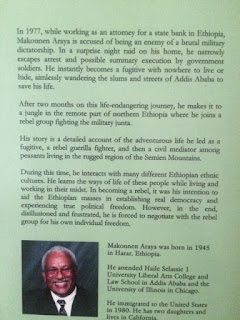
I am now a US citizen. I have two daughters and
live in California.

EDSP- What lasting impact did your experiences in the Ethiopian Civil War
have on your life, and what lessons did you learn from those tough times?
It turned my life upside down. I was living a
good life and had a reliable profession. As could be expected, participation in
the armed struggle for freedom and democracy changed all that. Life forces on
us difficult situations we have to face headlong that require great patience
and a lot of sacrifice on our part. However, I have never had any regret; in
fact, I cherish the sacrifices I underwent in the struggle for democracy and
freedom [that began during the time of the Ethiopian Revolution and continues to
this day]. What I learned from those desperate times is that one should never
lose hope but continue in the struggle and do one’s best to turn the negative
situations into positive ones. Maintain a positive outlook on life.
EDSP-What motivated you to write
about your life experiences in Ethiopia?
I wanted to document my experiences in the
struggle for freedom and democracy.
Prior to this time there had always been obstacles holding me back from
fulfilling my desire to do so. I finally
decided that since I had survived so many life-endangering experiences, it
would be a disservice to society and to my children to let this important piece
of history remain untold and lost forever.
EDSP-What is your greatest accomplishment?
From the positive and encouraging
receptions I received from readers, my book is one of my greatest
accomplishments. To see my hard work produce such a book that makes sense,
order and coherence out of a confusing, complicated and chaotic civil war makes
me feel most fulfilled and satisfied.
Having carefully studied my book and all the
life-threatening incidents I had encountered, once a friend said to me, “You
have admirably made it through the eye of a needle.” To be able to survive and
get away unscathed from all those near misses from capture and certain death by
my enemies and to be able to tell my story to the world, I consider myself as
most blessed.


